
Published on “European View”, vol. 24, issue 1, Wilfried Martens Centre for European Studies
Abstract
Despite the traditional weakness of its economic system, due to high public debt, and the still very low level of defence spending among Western countries, Italy is now going through a period of political stability that makes it a privileged interlocutor within the EU. Prime Minister Giorgia Meloni has to face problems of internal balance in the government coalition, but at the same time she can boast a good relationship with President Donald Trump and his entourage. The Italian government is strongly determined not to break the transatlantic bond, being a potential mediator between the tough positions of the new US administration and the need for Europe to maintain a positive relationship with it. The internal political balance, the need for positive relations with the new US administration despite its positions on Ukraine, and the leadership on policies for the south and for Africa represent the main challenges for the conservative leader of the Italian government as she is called to dialogue with the European People’s Party.
Trump 2.0: Europe’s third wake-up call in a context of growing populism
Many observers consider Donald Trump’s victory in the US elections a wake-up call for Europe: in fact, Europe is on its third wake-up call in the last five years. The first one was the Covid-19 pandemic, the second the Russian aggression against Ukraine, and this third one, which might be the last if there is no immediate and effective reaction, is addressed not only to Europe but to all Western democracies. It comes in a context in which populism and nationalism are having an increasingly significant influence, while a sort of weariness of democracy seems to be afflicting the majority of Western citizens. But the Trump 2.0 era seems to be different: while the pandemic and the war in Ukraine have seen a politically united response from the EU, Trump’s coming to power in the US is extremely divisive, for both American and European politics. Europe, in fact, is seeing growing pro-Russian positions within it, both on the right and on the left of the political spectrum. These are accompanied by a new wave of anti-American sentiment, also demonstrated by the decline in popularity of Trump and his team. On the other hand, the faction in favour of the new US policy is very aggressive and can count on strong Russian interference and the support of powerful influencers, starting with Elon Musk.
Italy: strengths and weaknesses
This situation is particularly evident in Italy. To understand its dynamics, it is necessary to consider its strengths and weaknesses. On the political level, there is a clear asymmetry between the Italian and the European centre–right. In Brussels the centre–right is represented by the European People’s Party (EPP), which has other groups on its right. But in Italy the ruling coalition, which is also defined as centre–right, includes Forza Italia, a member of the EPP; Brothers of Italy (Fratelli d’Italia), associated with the conservatives; and Matteo Salvini’s League (Lega), which adheres to the extreme-right group of the Patriots. These differences in political vision are reflected in the government’s actions and its contradictions, especially concerning foreign policy.
From an economic point of view, the country has a very high public debt, which has always made it vulnerable compared to other EU countries, and globally. Paradoxically, the strength of its exports represents, at this historical moment, a critical element in its relationship with the US due to Italy’s high trade surplus, a fact disliked by President Trump. On the military level, defence spending is still far from the minimum threshold of 2% of GDP, agreed as early as 2014 between NATO allies and since then the subject of continuous discussions, especially with the US. This constitutes an obvious problem in relations with the new US administration, taking into account, in particular, the fact that this required percentage is inevitably going to rise.
Finally, the national system appears particularly vulnerable to Moscow’s influences, not only because of the frequency of cyber-attacks by Russian hackers, but also because of the long tradition of relationships between Moscow and Italy’s political subjects, starting with the League and its leader, which have been characterised by behaviours that are anything but transparent. But Italy today also has unquestionable strengths, starting with the stability of the government and the undisputed leadership of Giorgia Meloni, who has almost always maintained consistent lines of thought, particularly with respect to Ukraine.
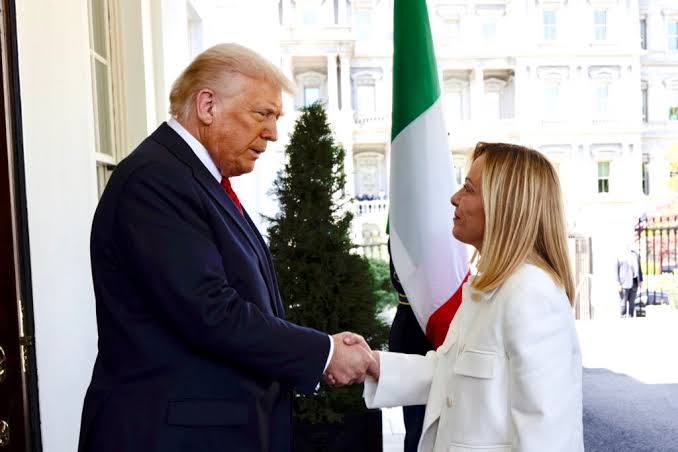
The good personal relationship between Meloni and Trump represents an interesting asset not only for Italy but, potentially, for the entire EU. The Italian prime minister is very determined not to break the transatlantic bond, despite the isolationist attitude of the US president, and her vision is shared by the leadership of the UK.
The country’s recent economic performance has been good, particularly concerning exports, such that Italy overcame Japan to become the fourth largest economy worldwide for the first six months of 2024 (Invenium Legaltech 2024), despite the slowdown in the economy of Germany, which has harmed several key Italian industrial sectors historically linked to German supply chains.
The country’s relationship with NATO is solid, and, despite the figure for defence spending, the Italian military has always contributed significantly to international missions (today the maximum total number of troops authorised by the Parliament is 14,500, with about 7,600 currently deployed in over 40 missions). The recent Global Firepower (2025) index places the Italian Armed Forces tenth in the world. The national defence industry ranks among the best in Europe in terms of technological quality and size.
The Italian diplomatic system is recognised as one of the most respected in the world.
Internal policy issues for Meloni
The challenges that await Meloni and her government are evident with respect to the management of the new transatlantic scenario.
It will not be easy for the Italian prime minister to keep her government coalition together. The consistent stance of the leader of the League, Matteo Salvini, against the continuation of military aid to Ukraine clashes with that of Antonio Tajani, Minister of Foreign Affairs, and Meloni herself. Salvini, in fact, makes it a question of internal political positioning, so as not to be crushed between the conservatives of Brothers of Italy and the centrists of Forza Italia.
Another critical front at the domestic level is the increase in defence spending, an issue on which there is strong cross-party resistance. It will be necessary for the government and Parliament to insist on the increase, and once again, Matteo Salvini himself will most likely be the hardest interlocutor to convince.
All this is part of a framework already made difficult by the complex process of internal reforms, starting with that of the judicial system, and by the delicacy of issues such as immigration.
Meloni appears to be in a position to maintain the balance necessary to overcome these challenges, but there is no doubt that the terrain is becoming increasingly treacherous for her. In this sense, she will need to shift her politics more and more towards the centre, to give security to the world of moderates, which still represents the vast majority of the national electorate.
Italy, foreign policy and impacts for Europe
On a European and international level, Italy is called upon to play a role that may be of fundamental importance, and it is precisely here that Meloni must juggle problems and opportunities.
The parties that now control the European Parliament look at her with some suspicion due to her presidency of the Conservative group from 2020 to 2025. In particular, it is essential for her to come to terms with an EPP that is stronger and more influential than before.
With the upcoming inauguration of its new Chancellor, Friedrich Merz, Germany is preparing to take the lead in Europe again. This is certainly good news for the EU, which cannot do without a strong Germany, and it is also good news for the countries that have close ties with Berlin, starting with Italy itself. Merz has already announced important economic measures for the relaunch and rearmament of his country, even at the cost of renouncing the traditional financial rigour.
Such a relaunch of Germany also offers a historic opportunity for Meloni—one that eluded her predecessors—namely the reconstitution of the Rome–Paris–Berlin axis, which would significantly strengthen the entire European project. And here one must not forget London, given the signals that British Prime Minister Keir Starmer is sending in the direction of Europe and the EU itself.
Meloni and Merz are the people most suited to carry out this operation, given President Macron’s weakness. The positive personal relationship Meloni has with Ursula von der Leyen—who, with Manfred Weber and the EPP, is showing great determination in leading the Union towards stronger political integration—will help the Italian prime minister. Significantly, the president of the European Commission quoted Alcide De Gasperi on the subject of common European defence recently, during her opening statement at the European Council meeting on European security, which could potentially be interpreted as an appeal to the role that Italy must still play today (Von der Leyen 2025). Meloni will therefore have to play along with the German coalition between the Christian Democratic Union (Christlich Demokratische Union) and the Socialists, something that will not be easy for her to make acceptable to her own party and to the League, whose leader has already declared that the party looks with sympathy at the Alternative for Germany (Alternative für Deutschland).
Italy’s determination not to break the transatlantic bond, also strongly supported by Foreign Minister and EPP Vice-President Antonio Tajani, is certainly positive and could be a key factor, at a time when the impulse to isolate Europe seems to predominate in Washington, especially in the president’s entourage. The main problem, in the short term, is finding a balance between the dialogue with Trump and the political position taken on Ukraine. In her speech to the American conservatives assembled at the Conservative Political Action Conference 2025, Meloni clearly reiterated her personal conviction regarding Russian aggression and the need to continue to support Kyiv (Imperiali 2025), but this is a balance that is not easy to maintain.
The presence of sectors of Italian public opinion easily influenced by Russian propaganda is also a point of great vulnerability for Europe. It is no mystery that Moscow has always considered Rome a sort of Trojan horse with respect to Brussels, thanks to historical relations with the circles of the left and the League itself, as well as with a part of the diplomatic system. A further pro-Russian drift in Italy would constitute a clear advantage for Moscow, building support, too, for its expansionist aims in the Western Balkans. The Italian intelligence system must act strongly and promptly against the continuous Russian influences, which just over a year ago touched Meloni personally, through an attack by the famous pair of pranksters Vovan and Lexus.
Perhaps the most critical element for Europe remains the opposition of Italian public opinion to the increase in defence spending. On this issue, the political debate is very heated, due in part to the presence of many pacifist components, particularly on the left and in the Catholic world. The debate is often factitious, as can be seen in the fact that Giuseppe Conte, the leader of the Five Star Movement (Movimento 5 Stelle), worked hard to bring military spending up to 2% of GDP when he was prime minister and is now fiercely opposed to the same decision. It is essential for the government to act decisively, and here, too, the League’s position does not help. Meloni herself was forced to counterbalance the vote in favour of the Re Arm Europe plan presented by von der Leyen by abstaining on the motion of support for Ukraine, contradicting her own personal position (Nubola 2025). If these wavering tendencies continue, they can only weaken the Italian position, and with it also the European one.
As a final element of complexity, Italy must not fail in its historic task of ensuring that Europe and NATO keep their eyes wide open on the southern flank. The excellent intuition of the Mattei Plan for Africa (Fattibene and Manservisi 2024) will help Meloni, but there is no doubt that the US withdrawal from the region and the urgencies of the eastern flank risk focusing interest in the south solely on the migration issue, which is certainly the tip of the iceberg, but does not represent its enormous complexity.
Conclusions
Whatever happens, the next few months will be full of news and further changes, starting with the stalemate into which the US could fall if Trump continues his autarkic and isolationist policies.
Putin will continue to increase pressure on Ukraine, and it will not be easy for Europe to replace the US in providing aid to Kyiv—although the situation may change, as Trump has already made more than one about-turn.
It remains to be seen if the dialogue between Trump and Putin could lead to a truce or even peace. Europe must not accept being excluded from the negotiations, nor allow agreements at the expense of Ukraine, which would move the Russian threat closer and closer to the EU, fuelling the neo-imperial logic of Moscow. The need to guarantee a just peace, however, seems to clash with Putin’s hegemonic aims.
Strengthening the European project, starting with a common defence, is the most important task if we want to save not only Europe but democracy in the world. And it is a strengthening that will have to take place while keeping the transatlantic relationship strong; otherwise it risks being unrealistic.
The Italian contribution will certainly be decisive and is mainly in the hands of Meloni, not forgetting a certain Mario Draghi.
References
Fattibene, D., & Manservisi, S. (2024). The Mattei Plan for Africa: A turning point for Italy’s development cooperation policy? Istituto Affari Internazionali, 11 March, www.iai.it/en/pubblicazioni/c05/mattei-plan-africa-turning-point-italys-development-cooperation-policy.
Global Firepower. (2025). 2025 military strength ranking, www.globalfirepower.com/countries-listing.php.
Imperiali, A. (2025). Giorgia Meloni at CPAC: A bridge between Europe and America. The Conservative, 23 February, www.theconservative.online/giorgia-meloni-at-cpac-a-bridge-between-europe-and-america.
Invenium Legaltech. (2024). Export records for Italy in the first half of 2024. 2 October, www.invenium-legaltech.com/en/export-recors-for-italy-in-the-first-half-of-2024.
Nubola, V. (2025). Defense, EU Parliament approves European rearmament plan: Yes from FI and FdI, against Lega M5S and Avs. The PD splits. Firstonline, 12 March, www.firstonline.info/en/defense-eu-parliament-approves-european-rearmament-plan-yes-of-fi-and-fdi-against-league-m5s-and-avs-the-pd-splits.
Von der Leyen, U. (2025). Speech made at the European Parliament Plenary joint debate on European Council meetings and European Security, Strasbourg, 10 March 2025, https://ec.europa.Eu/commission/presscorner/detail/en/speech_25_739.